The work of the PBMS was presented at the recent annual European conference for the Society of Environmental Toxicology and Chemistry (SETAC) held in Maastricht 17th to 21st May 2026.
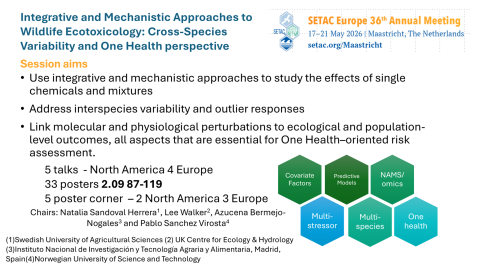
Lee Walker, lead scientist for the PBMS, co-chaired the session entitled ‘Integrative and Mechanistic Approaches to Wildlife Ecotoxicology: Cross-Species Variability and One Health perspective’. This session was convened by researchers from the UK, Denmark, Norway and Spain with presentations from studies in Europe, North America and South America. Studies presented covered the application of omic technologies to characterise the gene expression, and metabolic, response to pollutant exposure, and the incorporation into chemical risk assessment of physiological and population-level effects.
In addition to the session, Lee and a PBMS colleague, Glória Pereira, were co-authors on a study presented by poster on ‘Understanding Spatial Patterns of PFAS1 Exposure for two Terrestrial Species in the UK’. The latter presented a preliminary analysis of PFAS residues in the common buzzard and red fox.
The buzzard data was generated as part of projects conducted by UKCEH through the PBMS that are funded by Natural England. The tissues used were from the PBMS tissue archive which is funded by the UKCEH National Capability for UK Challenges Programme NE/Y006208/1, Natural England, and the Campaign for Responsible Rodenticide Use. Fox data was generated by projects conducted by Fera Science supported by Natural England.
Preliminary of PFAS residues in livers of the common buzzards and red fox, and subject to refinement, found that: -
• PFAS were detected in all livers sampled, but the exposure profile of individual PFAS detected and spatial patterns differed between species.
• Area of historic landfill within assumed home range may be more likely to influence exposure patterns compared to area of arable land (proxy for biosolids application).
Reflecting on the conference as a whole, Lee said “The SETAC conference usually reflects current and emerging concerns related to chemical risk to our environment and humans directly, and this year was no different. There was a noticeable increase in the number of sessions dedicated to studies measuring and predicting release and fate within the environment, and the responses within organisms, populations and communities.”
In addition, there were a significant number of studies presented on plastics and plastic additives, and metals. At SETAC, UKCEH colleagues contributed to many of these sessions, a summary of which can be found on our website here: UKCEH at SETAC Europe 2026
1 PFAS stands for per- and polyfluoroalkyl substances. They are a large, synthetic family of thousands of man-made chemicals widely used in everyday consumer and industrial products because they repel water, grease, and heat.