The work of the PBMS team featured in this year’s Royal Society of Chemistry Exposure Science conference. Held at the UKCEH Lancaster research facility on the 21st and 22nd of April 2026, the conference brought together experts and regulators focused on the human and environmental exposure to chemical contaminants and its consequences.
Lee Walker, the lead scientist of the PBMS, gave a key-note speech on ‘The Predatory Bird Monitoring Scheme: Citizen Science that helps us to understand contamination in raptors and our shared environment’. This presentation covered the aims of the scheme and how it works practically. Lee also gave examples of how monitoring by the PBMS has been used for evidence based chemical management, such as the instigation of the UK Rodenticide Stewardship Scheme.
Shinji Ozaki also presented our recent work, funded by Natural England, on ‘Season as a significant factor in detecting trends of multiple chemicals in terrestrial raptors’. Furthermore, two posters were presented from PBMS team members; Elaine Potter on ‘Restoring apex predator monitoring after the impact of bird flu‘, and Shinji Ozaki on ‘Rodenticide threshold values for predatory birds: Application of a probabilistic modelling approach to bird specimens found dead’.
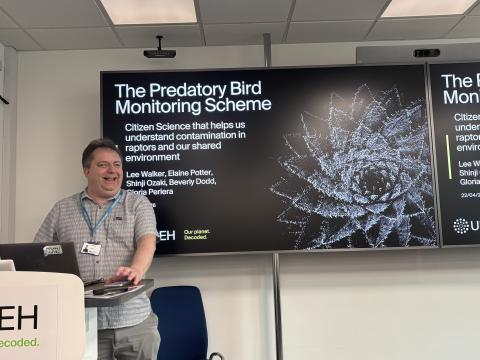
at the Exposure Science 2026 conference in Lancaster
“This was a fascinating couple of day with presentations and discussion highlighting some shared challenges between human and environmental monitoring.” Lee comments, “There is also an opportunity to share approaches and methods that can tackle those challenges and make the most of our monitoring.”